
There is a distinct, almost palpable magic that occurs when the temperature drops and the kitchen fills with the heady aromas of cinnamon, nutmeg, molasses, and toasted butter. For generations, baking has been the ultimate expression of holiday warmth, yet achieving bakery-level perfection with seasonal classic cookies often leaves home bakers feeling frustrated. Have your intricately cut sugar cookies expanded into unrecognizable blobs in the oven? Does your gingerbread lack that quintessential snap? Is your royal icing bleeding colors or refusing to set?
Welcome to the ultimate masterclass in festive baking. This is the only guide you will ever need to perfect the art of the holiday cookie tin. Whether you are prepping for a competitive cookie exchange, building a gingerbread architectural masterpiece, or simply continuing a cherished family tradition, we are going to dive deep into the science, techniques, and insider secrets of holiday baking. By understanding the specific chemistry of rolled doughs, royal icing, and spice blooming, you will elevate your bakes from homemade to professional.
What You Will Learn in This Guide:
- The scientific principles of spread-prevention in cut-out cookies.
- How to properly bloom spices to maximize the flavor of your seasonal bakes.
- Master techniques for rolling dough evenly and achieving flawless royal icing consistencies.
- The “Two-Chill Method” for razor-sharp cookie edges.
- A comprehensive troubleshooting guide for common holiday baking disasters.
- Advanced strategies for freezing, storing, and shipping cookies without breakage or moisture migration.
- Links to our specialized cluster recipes to build the ultimate holiday cookie box.
The Science & Fundamentals of Seasonal Classic Cookies
Baking is applied chemistry, and holiday cookies present a unique set of scientific challenges compared to your standard drop cookie. When making cut-outs, spritz, or molded cookies, the primary goal shifts from achieving a gooey center to maintaining precise structural integrity.
The Chemistry of Spread Prevention
The ultimate enemy of a beautifully stamped or cut cookie is “spread.” Spread is dictated by a combination of hydration, fat temperature, and leavening.
- The Absence of Leavening: Unlike chocolate chip cookies, which rely on baking soda and baking powder for lift, perfect cut-out sugar cookies often use little to no chemical leavening. Baking powder produces carbon dioxide gas that causes the dough to puff and expand, ruining sharp edges. By relying solely on mechanical leavening (creaming butter and sugar) and the steam from the butter’s water content, we achieve a tender crumb without sacrificing the cookie’s physical footprint.
- Flour Hydration and Gluten Network: Cut-out cookies require a slightly higher ratio of flour to fat to build a sturdy framework. We want to develop just enough gluten to hold the shape, but not so much that the cookie becomes tough. This is why resting the dough is crucial; it allows the flour to fully hydrate and the gluten strands to relax, preventing the dough from shrinking back when rolled.
Molasses and Hygroscopy in Gingerbread
Gingerbread relies heavily on molasses, a thick, dark syrup derived from sugar cane refining. Molasses is deeply hygroscopic, meaning it aggressively attracts and retains moisture from the air. This is why a well-baked gingerbread cookie can start out crisp, but soften beautifully over a few days in a sealed tin. Furthermore, the slight acidity of molasses reacts with the baking soda typically found in gingerbread recipes to create a delicate, porous structure that perfectly captures the complex spices.
The Maillard Reaction & Spice Blooming
The Maillard reaction—the browning of proteins and sugars under heat—is essential for developing the savory, roasted notes of a great cookie. But in seasonal baking, spices are equally important. Spices like cinnamon, ginger, cloves, and nutmeg contain volatile flavor oils.
- Fat-Soluble Flavor: These volatile oils are fat-soluble. To achieve a truly explosive holiday flavor profile, professional bakers often “bloom” their spices by mixing them directly into the butter during the creaming stage, rather than whisking them into the dry flour. The fat encapsulates and amplifies the essential oils, carrying them evenly throughout the dough.
The Physics of Royal Icing
Royal icing is essentially a fluid meringue. It relies on the protein structure of egg whites (or meringue powder) whipped with powdered sugar. As the water in the icing evaporates, the sugar crystallizes around the protein network, creating a hard, matte finish that protects the cookie and allows for intricate, stackable designs. The speed of this crystallization is highly dependent on ambient humidity.
Essential Equipment & Ingredients for Seasonal Classic Cookies
Precision is paramount when crafting cookies meant for gifting and display. The right tools and ingredients will drastically reduce your frustration and elevate your final product.
The Non-Negotiable Tools
- Adjustable Rolling Pin with Thickness Rings: Eyeballing dough thickness is the leading cause of uneven baking. Some cookies will burn while others remain raw. An adjustable rolling pin with 1/4-inch or 3/8-inch guides ensures uniform thickness across your entire slab of dough.
- Heavy-Gauge Light Aluminum Baking Sheets: Dark pans absorb too much radiant heat, causing the bottoms of your delicate sugar cookies to brown before the centers set. Thick, light-colored aluminum provides gentle, even heat distribution.
- Perforated Baking Mats (Silicone Mesh): While parchment paper is excellent, a perforated silicone baking mat (like Silpat) allows microscopic amounts of heat and air to reach the bottom of the cookie, creating a perfectly flat, micro-textured bottom that is ideal for icing.
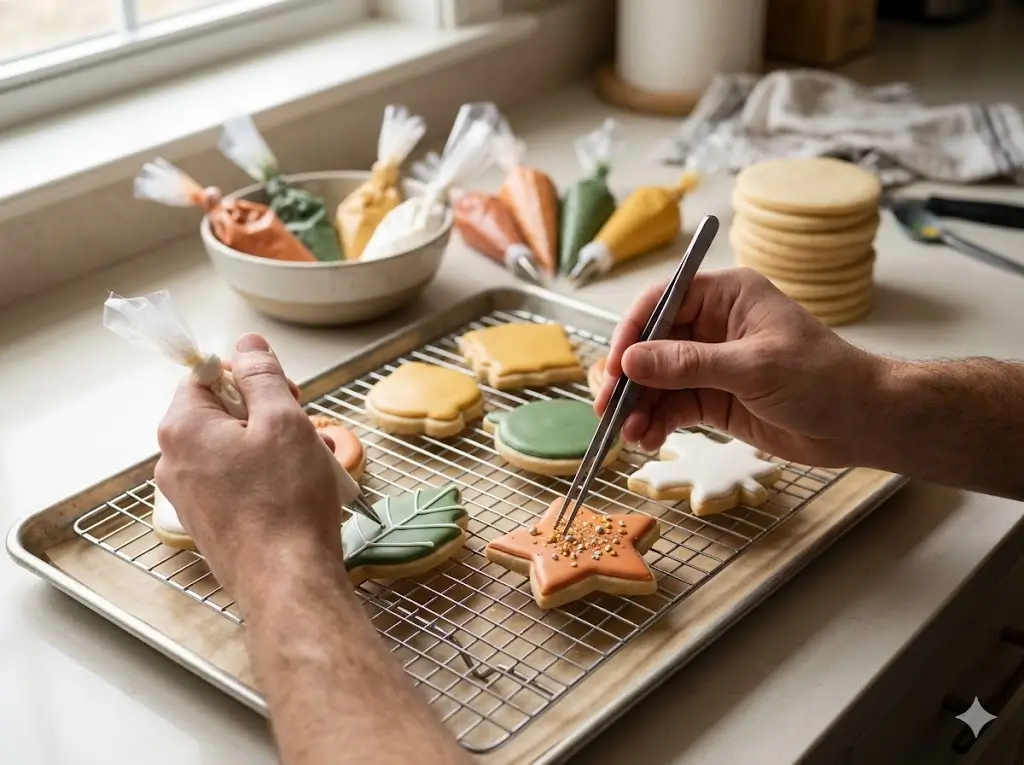
- Tipless Piping Bags & Scribe Tool: For royal icing, tipless bags allow for extreme precision without the hassle of washing metal tips. A scribe tool (a sharp, needle-like instrument) is essential for popping air bubbles in wet icing and dragging colors to create wet-on-wet designs.
Why Ingredient Quality Matters
- Meringue Powder vs. Raw Egg Whites: For royal icing, always use high-quality meringue powder. It provides a more stable, consistent drying time than raw whites, completely eliminates any food safety risks (like Salmonella), and often contains trace amounts of vanilla and cream of tartar to stabilize the protein structure.
- Pure Extracts and Emulsions: Holiday cookies are flavor-forward. Avoid imitation vanilla or almond essence at all costs; their chemical origins become glaringly obvious when baked. For an even stronger flavor punch, use baking emulsions, which suspend the flavor oils in water rather than alcohol, preventing the flavor from flashing off during baking.
- High-Fat European Butter: For Spritz cookies and shortbread, the fat is the flavor. Using a European-style butter (82-84% butterfat) rather than standard American butter (80%) provides less water content, reducing gluten development and ensuring a melt-in-your-mouth, sandy texture.
The Recipe Cluster Highlights
To build the ultimate holiday tin, you need variety in texture, flavor, and visual appeal. We have curated four distinct master recipes that form the foundation of any seasonal baking strategy.
Soft Frosted Sugar Cookies (The Cut-Out Kings)
This is the holy grail of holiday baking: a sugar cookie that holds razor-sharp edges in the oven yet yields to a perfectly soft, tender bite. Infused with a blend of pure vanilla bean paste and a whisper of almond extract, this dough is engineered to be rolled thick (1/4 inch). We use a precise ratio of powdered sugar in the dough—rather than granulated—to minimize spread and create a tight, velvety crumb that serves as the perfect canvas for your royal icing masterpieces. [Link to Full Recipe: Soft Frosted Sugar Cookies]
Classic Gingerbread Men (The Spiced Architecture)
Whether you prefer them soft and chewy or crisp and sturdy enough to build a house, this versatile dough does it all. Our recipe leans heavily into a robust spice blend—featuring dark molasses, ginger, cinnamon, allspice, and a secret pinch of finely ground black pepper for an authentic, warming bite. This dough is incredibly forgiving and actually improves in flavor if allowed to rest in the refrigerator for up to three days before rolling, allowing the complex spices to fully hydrate the flour. [Link to Full Recipe: Classic Gingerbread Men]
Buttery Spritz Cookies (The Melt-in-Your-Mouth Classics)
Spritz cookies (from the German word spritzen, to squirt) are rich, delicate, and practically dissolve on the tongue. Made using a specialized cookie press, this dough requires the exact opposite approach of a cut-out cookie: it must be supremely soft and pliable at room temperature to pass through the intricate metal discs. Flavored simply with high-fat butter and vanilla, these can be customized with food coloring, chocolate dips, or festive sprinkles for maximum visual impact with minimal effort. [Link to Full Recipe: Buttery Spritz Cookies]
Cinnamon Snickerdoodles (The Chewy Comforts)
No holiday spread is complete without the comforting, crackly exterior of a perfect snickerdoodle. The secret to their signature tangy flavor and iconic cracked, chewy texture is cream of tartar (tartaric acid). This acid inhibits sugar crystallization, keeping the interior soft, while reacting with the baking soda to puff the cookie up before it collapses into its beautiful, crinkled shape. Rolled generously in cinnamon sugar before baking, they are the essence of cozy seasonal comfort. [Link to Full Recipe: Cinnamon Snickerdoodles]
Step-by-Step Master Techniques for Seasonal Classic Cookies
Mastering these universal techniques will eliminate the stress of holiday baking and guarantee professional, bakery-window results.
1. The Two-Chill Method for Cut-Outs
If your cookies are losing their shape, you are skipping the most critical step. Heat is the enemy of structure.
- Chill One: After mixing your dough, divide it into two discs, wrap tightly in plastic, and refrigerate for at least 2 hours (or overnight). This allows the gluten to relax and the flour to hydrate.
- The Roll: Roll the cold dough out between two sheets of parchment paper. This eliminates the need for excess dusting flour, which can make the dough tough and alter the recipe’s hydration.
- Chill Two (The Pro Secret): Once you cut your shapes, do not move them. Slide the entire sheet of parchment with the cut shapes onto a baking pan and place it in the freezer for 15 minutes. Once the shapes are rock-hard, you can easily pop them out of the dough scraps and transfer them to your baking sheet. They will enter the oven freezing cold, guaranteeing zero spread.
Pro Baker Secret: Never re-roll your dough scraps more than twice. Every time you gather and roll the dough, you are developing more gluten. By the third roll, the cookies will be noticeably tougher and will shrink in the oven. Bake the final scraps as “baker’s treats” for yourself.
2. Mastering Royal Icing Consistencies
Royal icing is not a one-size-fits-all medium. You must manipulate the hydration to achieve different effects.
- Stiff Consistency (For Details & Florals): Straight out of the mixer. It should hold a stiff peak without drooping. Used for piping borders that won’t budge, creating leaves, or building gingerbread houses.
- Piping Consistency (The Outline): Add water a few drops at a time until the icing resembles toothpaste. It should easily pass through a bag but not flatten out immediately. This acts as a dam to hold your flood icing.
- Flood Consistency (The 15-Second Rule): This is the magic ratio for perfectly smooth, flat cookie surfaces. Add water until the icing flows like honey. Drag a butter knife through the bowl of icing; the line should completely disappear and level out in exactly 10 to 15 seconds. If it takes longer, it’s too thick. If it levels faster, it’s too thin and will run off the cookie.
3. The Perfect Spritz Press
Spritz cookies fail when the dough is too cold or the pan is prepped incorrectly.
- The Ungreased Pan: Do not use parchment paper, silicone mats, or butter on your baking sheet. The dough must stick to the bare, ungreased aluminum pan to detach from the cookie press.
- Temperature: The dough must be at a warm room temperature to extrude easily. If it’s too stiff, your press will break; if it’s too warm, the ridges will melt in the oven.

The Ultimate Troubleshooting Guide
Holiday baking happens in high-stress environments. Keep this diagnostic matrix on hand to rescue your seasonal treats from disaster.
| The Symptom | The Scientific Cause | The Expert Fix |
|---|---|---|
| Cut-out cookies spread and lost their shape. | Dough was too warm entering the oven, or too much baking powder/soda was used. | Utilize the “Two-Chill Method.” Freeze cut shapes for 15 minutes before baking. Ensure your recipe relies primarily on mechanical leavening. |
| Dough is crumbly and won’t come together. | Inadequate hydration, flour was packed tightly in the cup, or butter was too cold. | Weigh flour with a digital scale. If dough is still dry, sprinkle 1 tsp of milk at a time until it binds. Knead gently by hand to warm the butter. |
| Royal icing is bleeding colors (e.g., red bleeds into white). | Icing is too thin (too much water), or the base layer was not completely dry before adding details. | Thicken icing with powdered sugar. Most importantly, allow the base layer to dry in front of a circulating fan for at least 4 hours before piping contrasting colors on top. |
| Royal icing dries dull and splotchy (Butter Bleed). | The fat from the cookie has seeped into the porous icing as it dried. | Add a tiny dash of white food coloring (titanium dioxide) to your icing base to block fat absorption. Dry cookies quickly using a dehydrator or a desk fan. |
| Spritz cookies won’t release from the press. | Dough is too cold, or the baking sheet is too slippery (using parchment/non-stick spray). | Allow dough to warm slightly. Press directly onto a cold, bare, ungreased aluminum baking sheet so the dough has surface tension to grip. |
| Cookies are tough and snap like crackers. | The gluten was overworked, usually from excessive rolling and re-rolling of scraps. | Roll dough between parchment to avoid adding excess dusting flour. Limit re-rolling scraps to a maximum of two times. |
Dietary Adaptations & Substitutions
The holidays are about inclusion. Adapting classic structural cookies requires an understanding of how to replace gluten and egg proteins effectively.
Gluten-Free Cut-Outs & Gingerbread
Gluten is the glue that holds cut-outs together. When removing it, you must compensate to prevent crumbling. Use a premium 1-to-1 gluten-free flour blend containing xanthan gum. The Critical Adjustment: Add an extra egg yolk or 1 tablespoon of cream cheese to the dough. The extra fat and emulsifiers help bind the gluten-free starches. You must also chill the dough overnight; GF flours require significantly more time to hydrate, otherwise the cookies will taste unpleasantly gritty.
Vegan Royal Icing (Aquafaba Magic)
Meringue powder contains egg whites. To make vegan royal icing, you will harness the power of Aquafaba (the viscous liquid from a can of chickpeas). The proteins and starches in aquafaba whip up exactly like egg whites.
- The Formula: Reduce 1/2 cup of aquafaba on the stove until it measures 1/4 cup. Let it cool. Whip it with a hand mixer until foamy, then slowly beat in your powdered sugar and vanilla just as you would a traditional royal icing. It will dry hard, glossy, and completely egg-free (with absolutely zero chickpea flavor).
Dairy-Free Spritz & Shortbread
Because Spritz cookies rely entirely on the flavor and texture of butter, substitutions are tricky. Avoid standard margarines, which contain high water ratios that cause the dough to spread and boil in the oven. Use a high-quality, high-fat vegan block butter (like Miyoko’s Creamery). You may need to chill the dough for 10 minutes before pressing, as vegan butter melts at a lower temperature than dairy butter.
Advanced Storage & Make-Ahead Strategies
Holiday baking is a marathon, not a sprint. Knowing how to manipulate time through freezing and proper storage is the secret to producing massive quantities of cookies without losing your mind.
The Art of Freezing Unbaked Dough
The best time to bake a holiday cookie is the day you want to eat or gift it.
- For Cut-Outs: Roll the dough between parchment paper, stack the flat slabs on a baking sheet, wrap tightly in multiple layers of plastic wrap, and freeze. Shelf Life: Up to 3 months. When ready, let the slab sit at room temperature for 10 minutes until just pliable enough to cut, then cut your shapes and bake immediately.
- For Drop Cookies (Snickerdoodles): Roll the dough into balls, freeze them solid on a tray, and store them in zip-top freezer bags. Bake directly from frozen, adding 2-3 minutes to the bake time.
Storing and Preserving Decorated Cookies
Once royal icing is fully dry (allow 24 hours of ambient drying time), it acts as a protective seal, extending the cookie’s shelf life significantly.
- Airtight is Everything: Store fully dried decorated cookies in airtight containers layered with parchment paper. They will remain soft and fresh for up to two weeks at room temperature.
- Moisture Migration Warning: Never store crisp cookies (like gingerbread or spritz) in the same container as soft cookies (like snickerdoodles). In a sealed environment, moisture migrates from areas of high concentration to low concentration. The soft cookies will become hard, and the crisp cookies will become soggy.
Shipping Cookies Without Breakage
To ship your holiday tin across the country:
- Place the heaviest, sturdiest cookies at the bottom of the tin.
- Place a layer of bubble wrap or crumpled food-safe tissue paper between every single layer of cookies. There should be zero vertical movement when the lid is closed.
- Pack the tin itself into a cardboard shipping box filled with packing peanuts, ensuring at least 2 inches of padding on all sides.
Conclusion
Baking the perfect seasonal classic cookies is an incredible fusion of tradition and food science. By controlling your dough’s temperature, understanding the hydration of your royal icing, and mastering the nuances of spread prevention, you empower yourself to create edible art that tastes even better than it looks.
The holidays are stressful enough; your time in the kitchen should be a joyful expression of creativity. We invite you to explore our specialized cluster recipes linked above to start building your ultimate cookie tin. Did you try the Two-Chill method? Have questions about achieving the perfect flood icing consistency? Share your triumphs in the comments below, post your photos, and subscribe for more seasonal baking masterclasses!
Comprehensive FAQs about Seasonal Classic Cookies
1. How thick should I roll my sugar cookie dough?
For the best balance of a sturdy structure that holds icing and a soft, satisfying bite, aim for exactly 1/4 inch (about 6mm) thick. Anything thinner risks burning and breaking, while anything thicker may remain doughy in the center.
2. Why is my royal icing drying dull instead of shiny?
Shiny royal icing requires rapid drying. If your icing dries slowly in a humid environment, it will dry matte and is more prone to butter bleed. To achieve a high-gloss finish, place freshly flooded cookies directly in front of a circulating fan or place them in a food dehydrator on the lowest setting for 20 minutes.
3. Can I use store-bought frosting to decorate cut-out cookies?
Store-bought buttercream or frosting remains soft and contains high amounts of fat. While it tastes great, it will never dry hard. You will not be able to stack, ship, or individually wrap the cookies without the frosting smearing and ruining your designs. You must use royal icing or a crusting glaze for stackable cookies.
4. Why did my gingerbread men shrink and puff up in the oven?
Shrinking and puffing are signs of overdeveloped gluten. This happens when you add too much bench flour while rolling, or when you knead and re-roll the scraps too many times. Always roll between parchment paper to avoid excess flour, and try to cut as many shapes as possible from the first roll.
5. How long does royal icing take to completely dry?
While the surface of flood icing may feel dry to the touch in 1-2 hours, the icing underneath is still wet. For packing, stacking, or shipping, you must let royal icing dry completely at room temperature for a minimum of 18 to 24 hours.
6. Do I really need to use meringue powder?
Can I just use egg whites? While traditional royal icing is made with raw egg whites, meringue powder is highly recommended for safety, convenience, and consistency. Meringue powder eliminates the risk of salmonella, produces a more stable foam, and prevents the icing from breaking down or weeping over time.
7. Why are my spritz cookies spreading and losing their detailed ridges?
Spritz dough relies on the butter maintaining its structure until the flour sets in the oven. If your dough is too warm when it goes into the oven, the butter melts instantly, and the ridges flatten. Try chilling your ungreased baking sheet in the freezer for 5 minutes before pressing the cookies onto it.
8. Can I freeze cookies that have already been decorated with royal icing?
Yes, but you must take precautions to prevent condensation from ruining the icing when thawing. Place the fully dried, decorated cookies in an airtight container. Wrap the entire container tightly in plastic wrap and freeze. When you are ready to thaw, leave the container wrapped in the plastic at room temperature for 4-6 hours until fully thawed. Do not open the container until it is at room temperature, or condensation will form on the icing and cause colors to bleed.